How to homeschool in Colorado
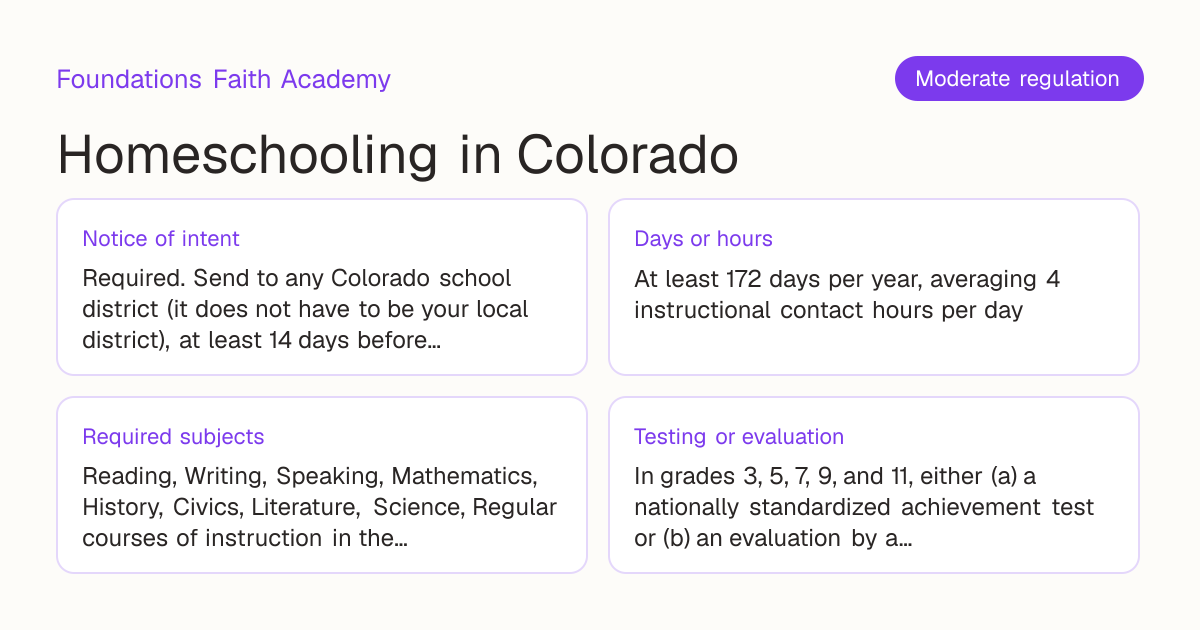
Colorado families send a written notice of intent to any Colorado school district 14 days before starting and every year after. You teach 172 days a year (averaging 4 hours a day) in the required subjects, and your child takes a standardized test or gets a professional evaluation in grades 3, 5, 7, 9 and 11. Families can instead enroll in an independent (private) school that supervises home instruction, or be taught by a licensed teacher.
Option 1: Nonpublic home-based educational program
The option most families use.
Nonpublic home-based educational program · C.R.S. § 22-33-104.5
A parent, guardian, or an adult relative the parent designates teaches the child at home under the homeschool statute. The program is not supervised by the school district, but it must follow the notice, time, subject, testing, and record rules below.
- Notice
- Send to: any Colorado school district (it does not have to be your local district).
- When: at least 14 days before starting the program, then annually while it continues.
- How often: annually.
- How: written notice to the district (CDE publishes a Notice of Intent template; certified mail with return receipt is a common way to keep proof).
- Instruction time
- At least 172 days per year, averaging 4 instructional contact hours per day.
- Required subjects
- Reading.
- Writing.
- Speaking.
- Mathematics.
- History.
- Civics.
- Literature.
- Science.
- Regular courses of instruction in the U.S. Constitution.
- Records to keep
- Attendance records (permanent).
- Test and evaluation results (permanent).
- Immunization records (permanent).
- Testing / evaluation
- In grades 3, 5, 7, 9, and 11, either (a) a nationally standardized achievement test or (b) an evaluation by a qualified person (a licensed teacher, a teacher at an independent or parochial school, a licensed psychologist, or a person with a graduate degree in education). Results go to the school district that received your notice, or to a Colorado independent or parochial school. A composite score at or below the 13th percentile (with an option to retest using a different approved test), or an evaluation showing insufficient progress, lets the district require enrollment in a school until the next testing period.
- Parent qualifications
- None (the parent, guardian, or a designated adult relative may teach).
- Also
- If the superintendent has probable cause to believe the program is out of compliance, you must produce your records within 14 days of a written request.
- A child who was habitually truant during the last six months of school attendance may start a home-based program only after the parents submit a written description of the curriculum along with the notice.
- Immunizations are required under Colorado health rules unless you file an official exemption.
Official form: Colorado Department of Education: Homeschool for Families (Notice of Intent template)
What the notice must include
- Name of each child.
- Age of each child.
- Place of residence.
- Number of hours of attendance.
Checklist
- Send a written notice of intent to a Colorado school district: at least 14 days before starting, then each year.
- Teach 172 days, averaging 4 hours a day: each school year.
- Keep attendance, test/evaluation, and immunization records: ongoing (permanent records).
- Give a standardized test or arrange a qualified evaluation and submit results: in grades 3, 5, 7, 9, and 11.
Option 2: Enrollment in an independent (private) school
Enrollment in an independent (private) school
Your child enrolls in a Colorado independent or parochial school that supervises your home instruction (sometimes called an umbrella school), or several families form their own independent school. The school, not the homeschool statute, sets the attendance, record, and testing rules.
- Notice
- Send to: the independent school you enroll in.
- When: at enrollment.
- How: the school's enrollment process.
- Testing / evaluation
- Set by the independent school.
Checklist
- Enroll in a Colorado independent school that supports home instruction: before you start homeschooling.
- Follow the school's attendance and reporting rules: ongoing.
Option 3: Instruction by a licensed teacher
Instruction by a licensed teacher
If the child is taught by a person holding a valid Colorado teaching license (which can be a parent), HSLDA reports that the homeschool statute's notice and assessment requirements do not apply.
- Notice
- Not required.
- Parent qualifications
- Valid Colorado teaching license.
Checklist
- Keep proof of the teacher's valid Colorado license: ongoing.
Leaving a public school
Colorado law does not set a special withdrawal procedure. File your notice of intent at least 14 days before starting, then notify the school in writing that your child is withdrawing to a home-based program.
Common questions about homeschooling in Colorado
- Do I have to notify anyone to homeschool in Colorado?
- Yes (for nonpublic home-based educational program, the option most families use). You send notice to any Colorado school district (it does not have to be your local district), at least 14 days before starting the program, then annually while it continues. How often: annually. Written notice to the district (CDE publishes a Notice of Intent template; certified mail with return receipt is a common way to keep proof).
- What subjects do I have to teach in Colorado?
- Colorado requires: Reading; Writing; Speaking; Mathematics; History; Civics; Literature; Science; Regular courses of instruction in the U.S. Constitution.
- How many days or hours of homeschool does Colorado require?
- At least 172 days per year, averaging 4 instructional contact hours per day.
- Are standardized tests or evaluations required in Colorado?
- In grades 3, 5, 7, 9, and 11, either (a) a nationally standardized achievement test or (b) an evaluation by a qualified person (a licensed teacher, a teacher at an independent or parochial school, a licensed psychologist, or a person with a graduate degree in education). Results go to the school district that received your notice, or to a Colorado independent or parochial school. A composite score at or below the 13th percentile (with an option to retest using a different approved test), or an evaluation showing insufficient progress, lets the district require enrollment in a school until the next testing period.
- Do parents need a teaching certificate to homeschool in Colorado?
- None (the parent, guardian, or a designated adult relative may teach).
- What records should I keep when homeschooling in Colorado?
- Attendance records (permanent); Test and evaluation results (permanent); Immunization records (permanent).
Worth double-checking
- Compulsory school age is 6 to 17. Notice is not required until the child turns 6, the program need not be established until age 7, and notice is no longer required after age 16.
- The independent-school and licensed-teacher routes come from HSLDA's guidance; we did not find CDE guidance describing them. Confirm with the independent school you choose.
- CDE states it cannot advise families on homeschooling and directs questions to the school district where you file.
- 2026 legislation (SB26-023, the School Finance Act) changed funding for public-school part-time homeschool programs; it does not change the home-based program requirements above.
Sources
- Colorado Department of Education: C.R.S. 22-33-104.5 (homeschool law).(official)
- Colorado Department of Education: Homeschool for Families.(official)
- Colorado Department of Education: Homeschool.(official)
- HSLDA: How to comply with Colorado's homeschool law.
This is a plain-language summary to help you get organized, not legal advice. Laws and forms change, so confirm the details with your state or school district before you file.