How to homeschool in New Jersey
New Jersey requires only that children ages 6 to 16 receive "equivalent instruction elsewhere than at school." You don't have to file a notice, follow a set curriculum, test, or keep specific records, and the district can't review or approve your program. If your child is already enrolled, the state encourages (but generally doesn't require) a letter to the superintendent saying you are homeschooling.
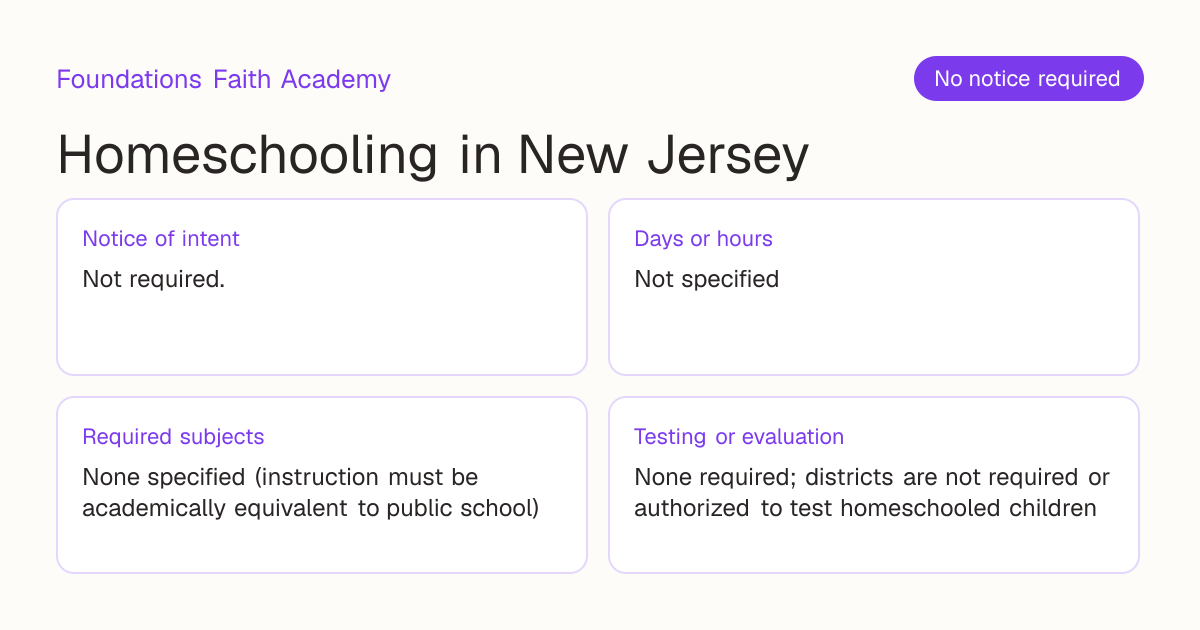
Requirements in New Jersey
Equivalent instruction elsewhere than at school · N.J. Stat. Ann. § 18A:38-25
Parents provide academically equivalent instruction at home. Courts (State v. Massa, 1967) require academic equivalence only, not equivalent social development; the local board of education may not review, approve, or monitor your curriculum or test your child.
- Notice
- Not required.
- Instruction time
- Not specified.
- Required subjects
- None specified (instruction must be academically equivalent to public school).
- Records to keep
- None required (a simple record of subjects, materials, and work samples helps if your district ever asks you to show equivalent instruction).
- Testing / evaluation
- None required; districts are not required or authorized to test homeschooled children.
- Parent qualifications
- None (no New Jersey teaching certificate required).
- Also
- Compulsory attendance ages are 6 to 16.
- If a district has credible evidence that a child is not being educated, it may ask for documentation such as a letter of intent; withdrawing to homeschool is not by itself such evidence.
What the notice must include
- Parent's name and address.
- Each child's name and age.
- A statement that the child is receiving equivalent instruction elsewhere than at school.
Checklist
- Withdraw your child from their current school in writing, if enrolled: before you begin homeschooling.
- Optional: send a letter of intent to your district superintendent: when you begin (encouraged, not required).
- Keep basic records of instruction in case your district ever questions equivalence: ongoing.
Leaving a public school
The NJ Department of Education says notice is generally voluntary, but it lists two situations where notice is needed: when removing an enrolled high school student (the district's transfer form), and after a district has refused to enroll a child (an intent to appeal or a verification statement under N.J.A.C. 6A:22-4.2(d)). A written withdrawal letter stating your child will receive equivalent instruction elsewhere than at school is the common practice.
Common questions about homeschooling in New Jersey
- Do I have to notify anyone to homeschool in New Jersey?
- No. New Jersey doesn't require a notice of intent for this option. If your child is enrolled in a public school, withdraw them in writing first.
- What subjects do I have to teach in New Jersey?
- New Jersey requires: None specified (instruction must be academically equivalent to public school).
- How many days or hours of homeschool does New Jersey require?
- Not specified.
- Are standardized tests or evaluations required in New Jersey?
- None required; districts are not required or authorized to test homeschooled children.
- Do parents need a teaching certificate to homeschool in New Jersey?
- None (no New Jersey teaching certificate required).
- What records should I keep when homeschooling in New Jersey?
- None required (a simple record of subjects, materials, and work samples helps if your district ever asks you to show equivalent instruction).
Worth double-checking
- Penalties under N.J.S.A. 18A:38-31 apply if a child is not receiving equivalent instruction; once a parent shows they are homeschooling, the state bears the burden of proving the instruction is not equivalent (State v. Vaughn, 1965).
- Districts do not issue diplomas to homeschooled students; options include the GED or college credits, per the NJDOE FAQ.
- Some districts ask for more than the law requires; you can point them to the NJDOE homeschooling FAQ.
Sources
This is a plain-language summary to help you get organized, not legal advice. Laws and forms change, so confirm the details with your state or school district before you file.